
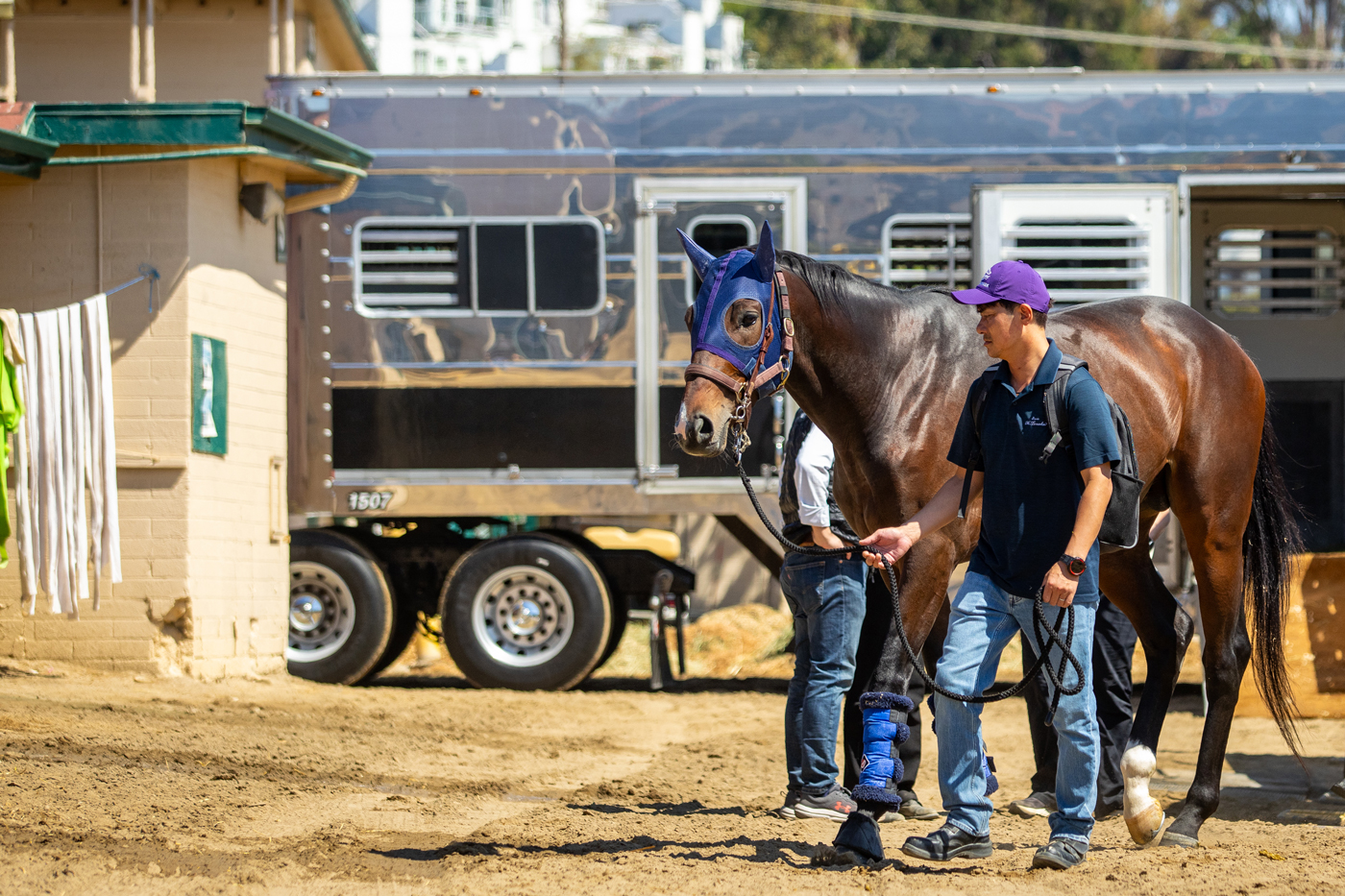
Finger Arriving at Del Mar for the 2026 Pacific Classic © Zoe Metz Photo
In two weeks, Del Mar will serve up its marquee event of the Bing Crosby Season, the FanDuel Racing Turf Festival. Nine races, eight on the grass and one on the dirt, eight of them graded stakes. It’s the biggest weekend of racing at Del Mar outside of Pacific Classic Day and attracts horses from all over the country and from some of the biggest stables in horse racing. Trainers Chad Brown, Brad Cox, Graham Motion and Todd Pletcher have all participated in the Turf Festival over the years and several of them are expected back this year.
But for them to engage their horses in the races at Del Mar they need to get them to the seaside oval. That involves some planning, a lot of hard work and thousands of miles since they’re coming from Kentucky or New York or other places east of the Mississippi. The shipping of horses has become an integral part of racing and the ability to load a horse on a plane and take him or her anywhere in the world has opened up innumerable opportunities for owners and trainers.
But for something that has become as common in horse racing as photo finishes, there is little known about the art of shipping horses. How is it possible to load a pent-up Thoroughbred weighing up to 1,200 pounds in a metal crate, put said animal on an airplane and fly it to a destination that could take several hours to get to?
KC Casebeer is the sales manager and West Coast agent for Tex Sutton. Anyone who follows horse racing knows that Tex Sutton used to have a corner on the market when it came to shipping horses in the U.S. They were the go-to agency if you wanted to move a horse.
But in May of 2021 Tex Sutton’s lease on the Boeing 727 cargo plane they called ‘Air Horse One’ expired and the company decided not to renew. Instead they reorganized and today are more of a booking agent.
Casebeer, a bright young lady, gave us the “inside” insights into how our four-legged heroes are ferried from place to place.
“I’ve been around horses all my life in some way shape or form,” Casebeer replies. “I started with the company it’ll be five years in December. It was really just a luck of the draw, or being in the right place at the right time. I live in California and Tex Sutton didn’t have an agent in California at the time. I really knew more of the show horse people than the racehorses.”
But horses are horses and she jumped in.
“We organize the flights for the horses,” Casebeer says. “We take care of all the behind-the-scenes stuff. We’ll get a call from a trainer or owner who has a race or a competition coming up and we put the puzzle together. We make sure we find a flight that meets their needs.”
That puzzle includes booking a trailer to get the horses to the airport; the flight itself, and then arrangements for another trailer to pick up the horses at the destination airport and get them to the racetrack.
“We check with people on both ends,” Casebeer adds. “Make sure everyone knows when the horse is leaving and when it’s coming in. We arrange everything door to door including the ground transportation to and from the airport. The only thing we do not arrange is whoever is at the track to receive the horse.”
The important element is the flight and there are flights available once or twice a week for horses shipping to and from California.
“We have a schedule on our website,” Casebeer points out. “But really it’s just the trainers calling us up and telling us ‘Hey, I’ve got a race next Saturday. What have you got for me?’” And then we make it happen nine times out of 10.”
In the case of shipping horses, size does matter.
“The first question I ask is what is your ideal ship date,” Casebeer explains. “The next question is ‘How large are the horses?’ Do you need a single stall or a stall and a half. That helps me to determine if I have to find additional shares for you or can we put two horses in each container and send them on their way.”
One would think there would be a vetting process since you are dealing with temperamental racehorses in enclosed areas. Horses are required to be gate schooled so when they get to the gate on race day they won’t throw a fit. But apparently that’s not an issue in the shipping business.
“Shockingly enough, as long as they have a full hay net in front of them, they can really care less,” Casebeer insists. “When I first started doing this I was amazed. As long as they have some food in front of them, they really don’t care. A lot of these horses are frequent flyers. They fly more than humans do.”
Medicating a horse is out of the question unless you’re shipping weeks in advance of a race. You can’t afford to have traces of a drug lingering in the animal’s system by the time pre- or post-race drug tests are conducted.
Humans have been shipping horses for centuries. Many a settler literally ‘shipped’ his horses across the ocean to the New World. Later, the railroad came along and horses shipped across country on the steel rail.
During the height of Seabiscuit’s fame in the late 1930s, horse transportation by plane did not exist, so instead owners and trainers relied on the railroad to get their horses from track to track. Seabiscuit’s owner, Charles Howard, famously used a customized, luxury railcar to transport the horse back and forth between the East Coast and California. That was the case when he went back to Maryland for his match race against War Admiral.
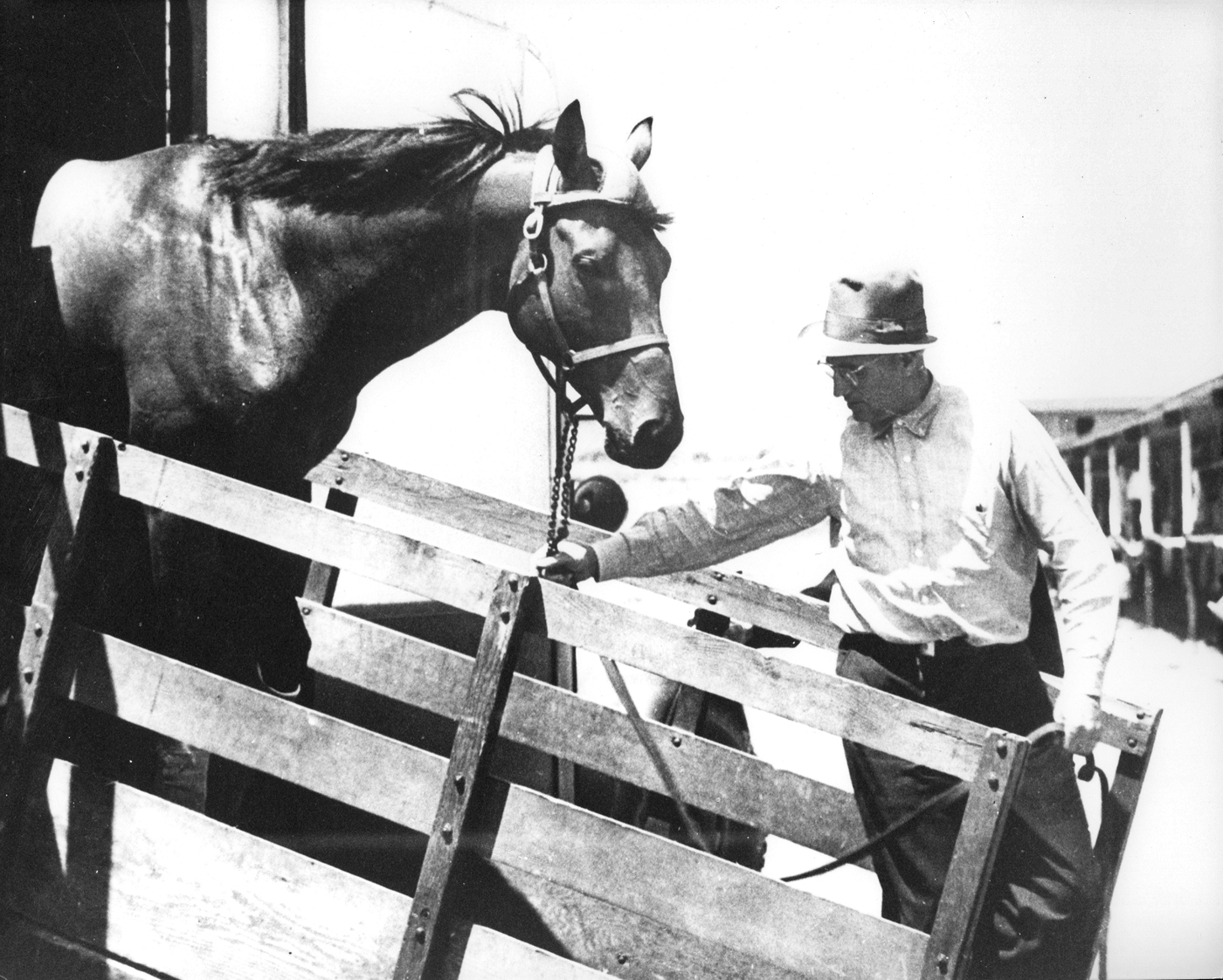
Seabiscuit Ships into Del Mar
Over his career, Seabiscuit logged over 50,000 miles by rail. His cross-country journeys often turned into coast-to-coast media events complete with whistle-stop appearances. Engineers would sound the train's whistle as they passed through towns, drawing massive crowds to the tracks just to catch a glimpse of Seabiscuit and his specialized railcar.
It wasn’t until 25 years after Orville and Wilbur Wright took off at Kitty Hawk in 1903 that the first horses were shipped by air. One of those is believed to have been a horse named Wirt G. Bowman, a prized Thoroughbred owned by Baron Long, one of the contractors who helped build Agua Caliente Racetrack. He flew his horse 500 miles from his stable in San Diego (records don’t specify if it was Del Mar or not) to Tanforan Racetrack in San Bruno, outside San Francisco, in 1928.
Tanforan had a landing strip on the property, so the plane taxied right up to the track and they walked over to the barn area. To show how comfortable the flight was for Wirt G. Bowman, he worked three furlongs soon after walking off the plane.
The first transcontinental flight occurred on May 29, 1946 when the racehorses Chakoora and Uleta were flown from New York to Hollywood Park. The first transatlantic shipment took place six months later when six Irish horses were shipped from Ireland to California on an American Airlines DC-4.
“The bottom line is keeping the horses safe during the flight,” Casebeer contends, “and having a smooth process door-to-door. Whether it’s a show horse or a racehorse, that’s a pretty fundamental thing.”
As one would expect, it’s not cheap hauling a racehorse from one city to the next by plane. The cost easily runs four figures.
“It fluctuates what with the fuel costs the way they are right now,” Casebeer notes, “but we’re talking thousands of dollars. There are a lot of variables that go with it. Do you want your horse in a single stall? Are you sending equipment. Plus, all the horses travel with two professional grooms on board for each flight.”
Then there’s the expense of getting the horse from the airport to the racetrack.
“In California there are two airports that we use, LAX and Ontario,” Casebeer explains. “It’s not as close as we could get to Del Mar but when you’re shipping across the country you’re still talking about a day trip instead of three or four days on a truck.”
The three companies Tex Sutton uses on the west coast for transporting horses to the racetracks from the airport are Hubbard, Brook Ledge and KC.
“They’re used to going to the airports and all the tracks for us,” Casebeer says. “We’ll book whoever the trainer usually uses. We only do domestic but we share a lot of the same customers with I.R.T. (International Racehorse Transport) or Mersante, which primarily do international flights.”
Business is brisk these days for Casebeer and Tex Sutton.
“We’ve gotten a lot busier,” Casebeer adds. “When Tex Sutton first started it was primarily the racehorses but over the past few years we’ve picked up a lot of show horses.”
And they’re not confined to shipping just horses.
“Everybody can ship,” Casebeer concludes. “Many horses have goats as stall buddies. We’ll ship the goats, too.”