
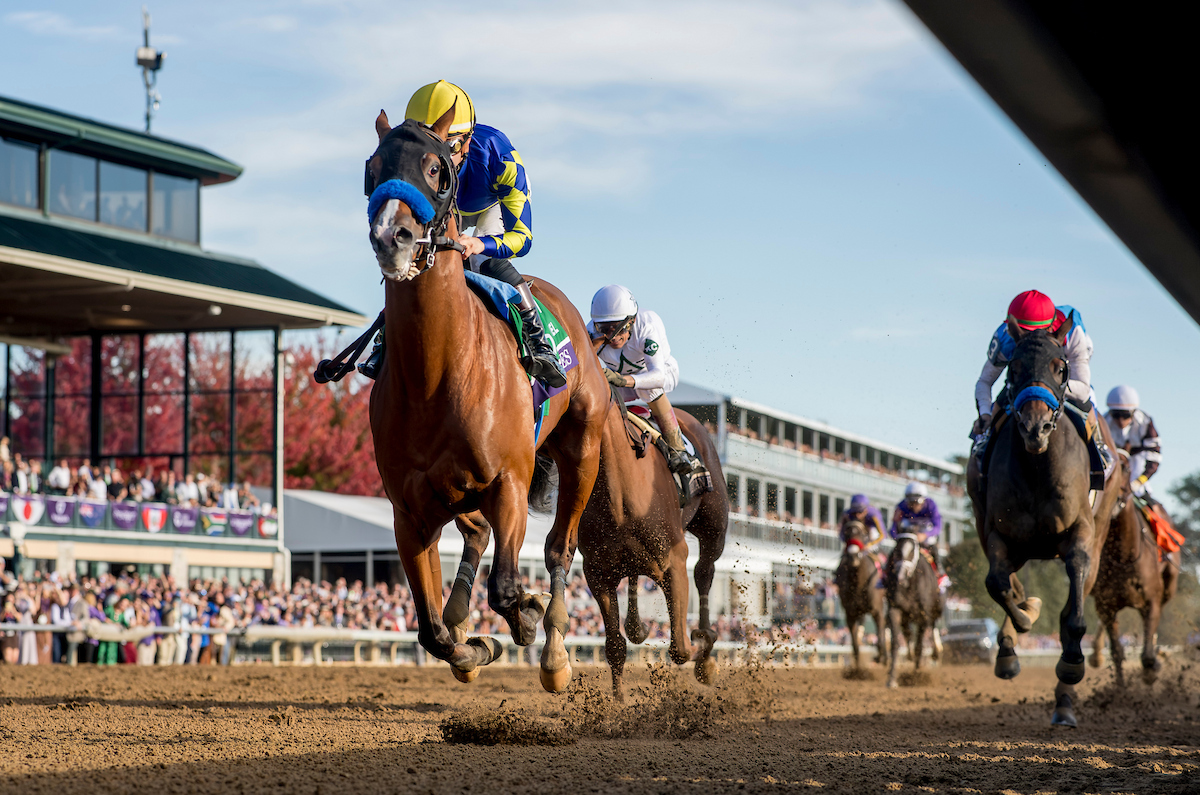
Hughes © Eclipse Sportswire / Breeders’ Cup Photos
Named for Olympic gold medalist hockey player Jack Hughes, the bay colt Hughes ($3.64) delivered a Championship-winning performance as the heavy favorite Saturday to score a 2 ¼-length victory in the $2 million FanDuel Racing Breeders’ Cup Juvenile presented by Thoroughbred Aftercare Alliance (G1).
Hughes, trained by Hall of Famer Bob Baffert, stayed perfect through five starts and likely locked up the Champion 2-year-old Male Eclipse Award title. It was Baffert’s seventh win in the Juvenile and 22nd in the Breeders’ Cup.
Under jockey Flavien Prat, Hughes was involved from the start of the 1 1/16-mile race at Keeneland Race Course. He handled challenges throughout the prestigious test, seized the lead in the second turn and, after turning back a looming trio of foes, opened up a comfortable advantage in the stretch. American History overcame trouble to finish second, edging Hughes’ stablemate Salahudin by a head. Hughes was sent off as the 4-5 favorite in the field of six, and reached the wire in 1:42.27 over the fast dirt.
“You know, sometimes they make it look easy, but easy ain’t easy,” Baffert said. “I was very proud of both of my horses. This horse had never been in a battle, and he really battled. He was very impressive. The fractions were pretty hot and this horse hadn’t been asked to do that, so you don’t know how they’re going to respond. I never let him do that in the morning.”
The ownership group of Front Row Club LLC, Starlight Racing, Madaket Stables LLC, Stonestreet Stables LLC, Bashor Racing LLC, Albaugh Family Stables, LLC, Robert E. Masterson, Golconda Stable, Waves Edge Capital LLC and Catherine Donovan named their Into Mischief colt after New Jersey Devils’ forward Jack Hughes, who scored the winning goal for Team USA in the Winter Olympics in February. Throughout his short career, Hughes has shown that he is worthy of carrying the name of an American sports hero. The FanDuel Racing Juvenile was his third Grade 1 triumph.
Bred in Kentucky by Breffini Farm, Hughes romped to easy victories in his first four races in California. He had to show some grit in the Juvenile. Early on, it was Damavand who set a pressured pace, and the pair covered the first quarter in :23.36 seconds and got the half-mile :46.65. After Damavand tired, Coach Pope moved up to challenge. They ran together into the second turn and reached six furlongs in 1:10.86.
When Hughes put Coach Pope away in the stretch, American History and Salahudin took up the chase.
“He had never been battle-tested so I didn’t know how he was going to react,” Baffert said.
Baffert added that Hughes showed his versatility and class.
“He’s so light on his feet, “Baffert said. “Everyone who gets off him says he’s like a cheetah. He skips over the ground and he comes back and he never takes a deep breath. Today we saw something we were hoping to see, but you knew he was going to have to take it to the next level.”
From Prat’s perspective, the race had some tense moments.
“His trip was good. He was going to switch off around the (first) turn and I don’t know if someone hit his heel because then he got keen on me,” Prat said. “Once I got going into the last turn, he finally dropped the bridle, took a breather, and not where I wanted to do it, but he did and then he was game after that. I didn’t know if he was going to be good enough to give me a run but he did. When he turned for home, he made a really good move. I was a bit worried the Todd Pletcher horse (American History) was making a run on us but my horse was good enough.”
Pletcher said he was pleased with American History’s performance under Hall of Fame jockey John Velazquez in what turned into a tough journey.
“(Velazquez) said he had a pretty rough trip around the first turn, even clipped heels a couple times,” Pletcher said. “When he got him back and out in the clear he regrouped and came on a little bit. But Johnny said the first turn was pretty rough. The horse was trying to lean on him in the middle of the (second) turn and Johnny was trying to hold him in—but I thought more significant was the (trouble in) the first turn. He got beat by the favorite, who ran a great race, and I think the American History ran great too. Could have been closer with a better trip around the first turn. Who knows?”